THE IMPORTANCE OF SLEEP
The importance of adequate sleep cannot be overstated. Sleep has many effects on a variety of aspects of our health. The way you feel awake has a link to what kind of sleep you get at night. Poor sleeping habits can lead to an acute sudden incident, such as a car crash due to a tired driver, or chronic problems over the long term such as a number of health issues.
Read More
DANGERS OF BENZENE IN THE WORKPLACE
Benzene is 1 of 119 agents listed as “carcinogenic to humans” by the International Agency of Research on Cancer also known as IARC. A carcinogen is defined as any substance or agent that tends to produce a cancer. It is a widely used chemical in industrial processes as well as in consumer goods. Because of its widespread use, many individuals can face exposure to this substance both on and off the job.
Read More
Muddy Work Areas
Weather can create many hazards and slow down production for construction sites and other work sites that are outdoors. This is especially true when rain creates excessively muddy conditions.
Read More
COLLECTION SAFETY SYSTEM PART 2 ( GENERAL SAFETY PRECAUTIONS)
The following are the proper procedures and general safety precautions that will be followed
before entering a manhole for the purpose of taking flow measurements, performing inspections
or making sewer repairs:
Read More
COLLECTION SAFETY SYSTEM PART 1 (SAFETY MEASURES)
The construction of sewers should be in accordance with standard design, with special attention
to self-cleaning velocities, good alignment, proper spacing of manholes, and adequate provision
for ventilation. These design standards when followed, will provide for a safer work
environment. However, there are several other points of safety that are of major importance.
Read More
SELF CONTAINED BREATHING APPARATUS (SCBA’S)
inspected on a regular basis, and are sanitized before and after use. The SCBA training video
will be viewed twice a year by all personnel.
Read More
Respiratory Protection Policy (Respirator Inspection - Respirator Certification )
The concentration of the hazard will be monitored before respirator selection and periodically
thereafter to ensure that the correct respirators are being utilized.
Read More
Employee Responsibility - Respirator Fit
Employees will use respirators provided in accordance with training received.
Employees must report any malfunction of a respirator to their supervisor immediately, and that
respirator will be taken out of service to be repaired or replaced.
Read More
WORK ZONE TRAFFIC CONTROL PART 6
To stop traffic
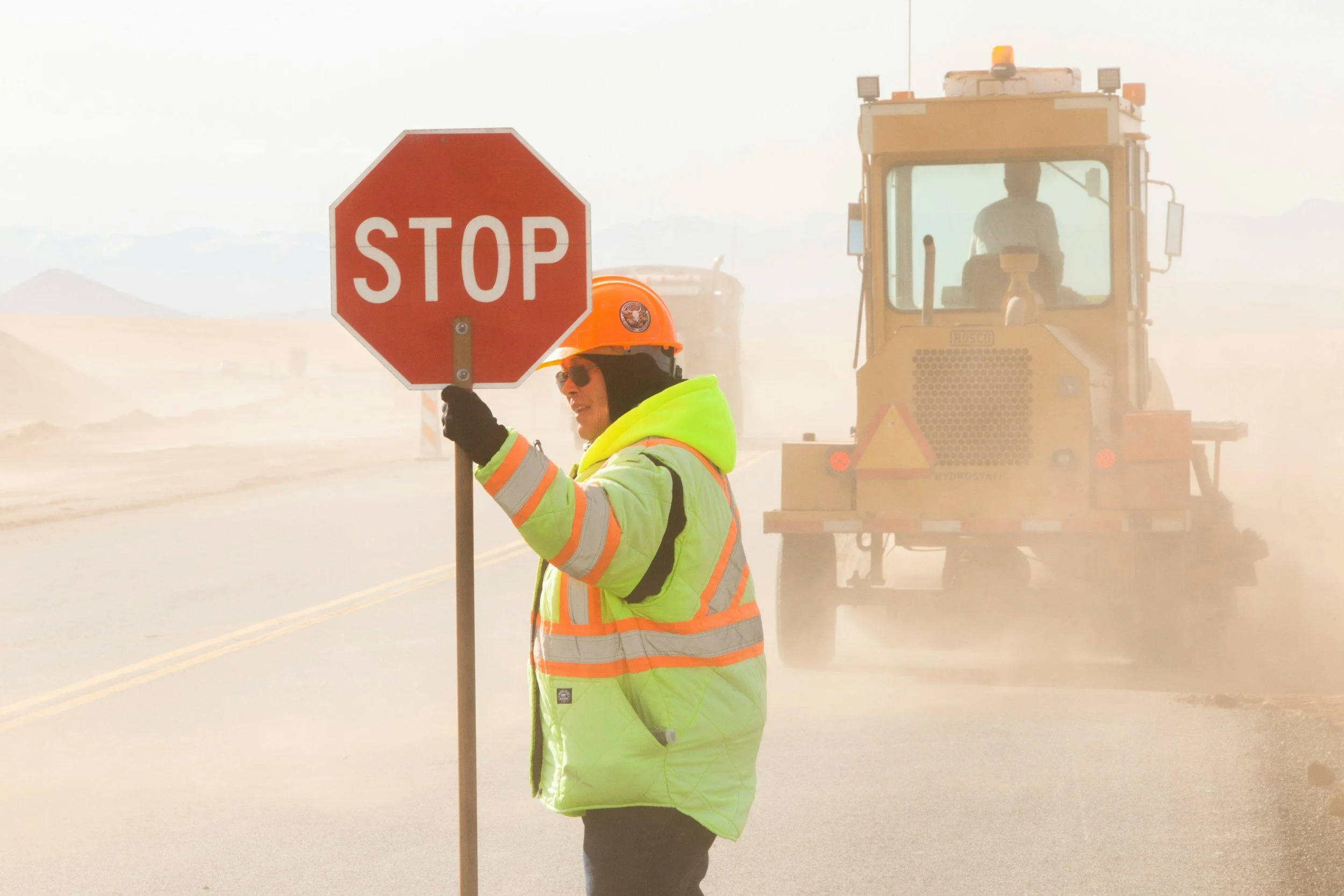
Stand in a safe position on the shoulder. Face traffic and extend the paddle in a vertical position
so the full STOP face can be seen by approaching drivers. Night flagging may include the use of
a red lantern or light. To stop traffic the light should be waved back and forth across the path of
an approaching vehicle
Read More
WORK ZONE TRAFFIC CONTROL PART 5
To you, the flagger:
You have been chosen as a traffic flagger because your supervisor feels you are physically able,
mentally alert, and sufficiently commanding in appearance to be obeyed by the motoring public.
You are an indispensable part of all maintenance and construction operations. We want you to
study the following instructions so that they become second nature. Your life, the lives of your
fellow workers, and the lives of highway users depend upon your alertness and on your ability to
control traffic with your stop-slow sign paddle.
Read More
WORK ZONE TRAFFIC CONTROL PART 4
LMK Pipe Renewal facilities on state highway right of ways are to be maintained in a manner
satisfactory to the State of Florida and at LMK Pipe Renewal expense.
Read More
WORK ZONE TRAFFIC CONTROL PART 3
Frequent and abrupt changes in geometries that require rapid maneuvers (such as lane narrowing,
dropped lanes, or main roadway transitions) should be avoided. Provisions should be made for
the safe operation of work vehicles, particularly on high-speed, high-volume roadways.
Read More
WORK ZONE TRAFFIC CONTROL PART 2
Any member of the crew who serves as a flagger should be equipped with a Stop-Slow paddle and a reflective vest. Crewmembers shall be trained for proper flagging procedures.
Read More
WORK ZONE AND TRAFFIC CONTROL PART 1
All requirements pertaining to the safety, employees in the above listed publications are included in this Safety Manual by reference. In this Safety Manual, it is not practical to prescribe detailed requirements for all situations that may arise; therefore, it is the responsibility of individual employees to determine applicability of the aforementioned publications to their own activities.
Read More
LITTLE THINGS
When planning work tasks for the day and addressing hazards it is easy get caught up on the big hazards. We focus on issues such as falls from heights, electrocution, and chemical asphyxiation during a confined space entry when they are present.
While these hazards need to be taken serious and properly addressed, the bigger hazards can be responsible for taking almost all of the attention from the “little things”….
Read More
NEW EQUIPMENT
Every single day new technologies and equipment are being introduced into the marketplace…..
Read More
S.O.R.T Tool
There is an endless amount of acronyms when talking about safety. The acronym S.O.R.T. is a tool that can help remind us to take steps to address hazards and create a safe work environment. S.O.R.T stands for Stop, Observe, Recognize, and Take Ownership.
Read More
TORNADO SAFETY
Tornadoes are a serious threat for many areas across the country. In an average year, about 1,000 tornados are reported in the United States, according to NOAA. Many of these tornadoes occur in the same geographical areas each year, however many places across the United States have the right conditions for a tornado. It is important to know about tornadoes and what to do both at home and work if there is one.
Read More
VEHICLE INSPECTIONS
While many accidents are caused by distracted driving and driving under the influence, mechanical issues also lead to accidents. Vehicle inspections and preventative maintenance are effective ways to prevent mechanical issue-related crashes….
Read More